Crawl spaces in central Illinois face severe seasonal vapor loading due to heavy clay soils and shifting water tables near Lake Springfield, Twin Lakes, and the Sangamon River basin. When unsealed ground moisture…
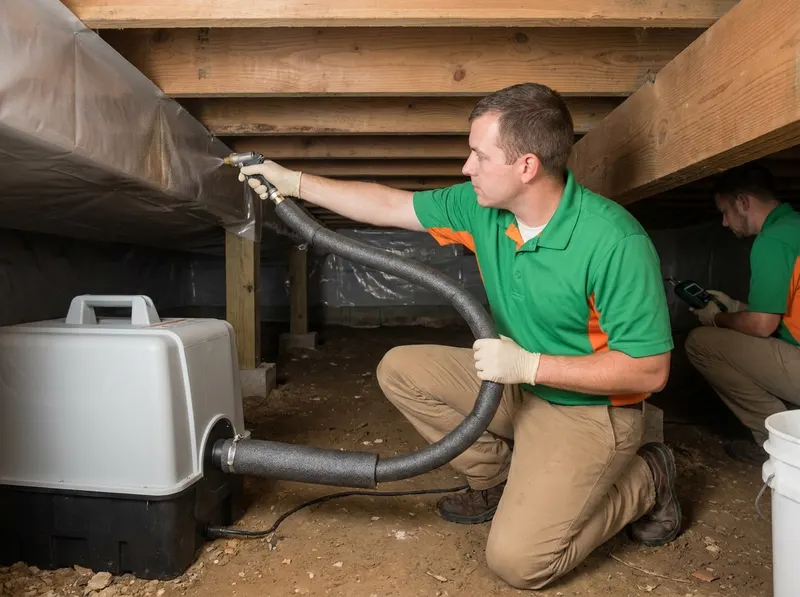
Crawl spaces in central Illinois face severe seasonal vapor loading due to heavy clay soils and shifting water tables near Lake Springfield, Twin Lakes, and the Sangamon River basin. When unsealed ground moisture rises, wood framing absorbs the ambient humidity, raising wood moisture content past 18 percent. This creates an ideal microclimate for subterranean termites, carpenter ants, and moisture-seeking silverfish. In historic properties across Enos Park, Vinegar Hill, and the Historic West Side, vented brick foundations frequently pull in humid summer air, causing condensation on subfloor joists. Standard surface spraying fails in these scenarios because synthetic pyrethroid barriers break down quickly on damp concrete, leaving structural wood exposed to colonization.
Effective remediation replaces open damp soil with a durable poly vapor barrier, mechanically sealed to the foundation piers and perimeter walls. If crawl space relative humidity registers above 70 percent, a low-profile dehumidifier system or vent cover sealing is matched to the foundation footprint; if the space registers dry with isolated surface condensation, passive ground-cover encapsulation resolves the vulnerability. Choosing complete ground encapsulation over simple spot chemical applications trades a slightly higher initial setup cost for permanent mechanical pest prevention and improved indoor air quality inside living spaces above. Subfloor framing in Leland Grove and Jerome homes treated with continuous 12-mil vapor barriers maintains stable structural integrity, preventing camel crickets and sowbugs from accessing wall voids through sill plates.
Property owners in neighborhoods like Westchester, Laketown, and Hawthorne Place benefit from an objective, step-by-step physical process: 1. A physical crawl space inspection measures joist wood moisture percentages and identifies insect entry points through foundation penetrations. 2. Debris, contaminated fiberglass insulation, and active biological growth are systematically removed from the subfloor perimeter. 3. A targeted structural pest barrier is applied directly to foundation wall footings and sill plates. 4. Continuous high-density vapor sheeting is rolled across 100 percent of exposed soil, overlapped by 12 inches, and taped at all structural foundation piers. 5. Foundation vent positions are calibrated based on seasonal outdoor dew points to prevent condensation buildup.
Every job gets a firm, written price after a free on-site visit.
Tell us about your crawl space moisture and vapor pest remediation job in Springfield and we'll send a clear, written quote, usually the same day.
 Savero Pest Patrol