Stinging insect defense requires precise identification of the nesting species and architectural vulnerability before applying treatment. In older Springfield neighborhoods like Enos Park, Vinegar Hill, and the…
Stinging insect defense requires precise identification of the nesting species and architectural vulnerability before applying treatment. In older Springfield neighborhoods like Enos Park, Vinegar Hill, and the Historic West Side, aggressive yellowjackets frequently exploit deteriorated mortar gaps, loose soffit transitions, and void spaces behind unbacked siding. A single established colony in late summer can contain between 1,500 and 4,000 workers. Simply spraying the exterior flight hole with over-the-counter aerosol repels the guard insects outward and drives the remaining colony deeper into wall cavities, where worker wasps chew through drywall paper to enter living quarters. Proper management involves injecting non-repellent active dusts directly into the void chamber, neutralizing the reproductive queen and brood, and sealing the void once activity ceases entirely.
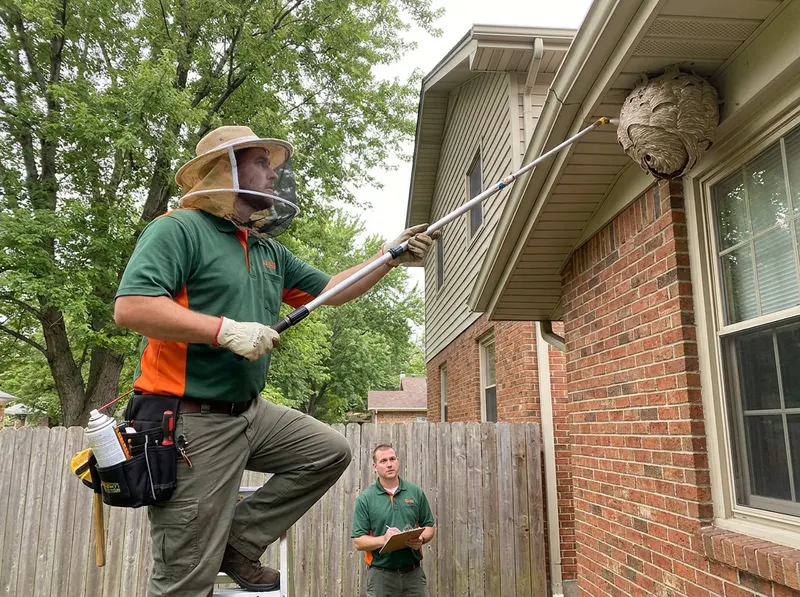
Properties situated near mature canopies and open water, such as lakefront structures near Lake Springfield, Twin Lakes, or timbered lots in Leland Grove and Jerome, experience severe exposure to bald-faced hornets and aerial wasps. Bald-faced hornets suspend fibrous, football-shaped paper nests from roof eaves, tree branches, or second-story overhangs. Unlike wasps, hornets defend their aerial perimeters aggressively up to 30 feet from the nest envelope. Eradication of these colonies requires targeted aerosolization of micro-encapsulated formulations delivered through pressurized extension lances, followed by the complete physical detachment of the paper envelope to prevent secondary pest infestations by carpet beetles and dermestids.
Decision-fit balances spot mechanical removal against structural Integrated Pest Management (IPM). For exposed, low-hanging paper wasp clusters beneath first-floor gutters in Westchester or Hawthorne Place, physical elimination coupled with a localized residual deterrent prevents seasonal rebuilds efficiently. For concealed European hornet or yellowjacket colonies inside exterior wall voids or attics, direct nest access requires specialized equipment. Exterior ground nests, common near residential gardens and landscaping ties around Laketown, demand localized liquid soil drenches and sub-surface dusting rather than wide broadcast spraying. The strategic goal remains focused on eliminating the biological nest core without saturating indoor air or indoor baseboards with off-target chemical agents.
Property owners can complete structural clearance across a four-stage process: 1. Confirm flight lines and monitor exterior entry openings from a minimum 15-foot distance. 2. Establish on-site inspection parameters by calling (327) 202-3618. 3. Technicians deploy targeted localized treatments directly into the active nest core during low-activity flight windows. 4. Complete final structural closure by applying silicone-based sealant or metal mesh to the entry portal after all residual colony movement has stopped.
Every job gets a firm, written price after a free on-site visit.
Tell us about your stinging insect and hornet removal job in Springfield and we'll send a clear, written quote, usually the same day.
 Savero Pest Patrol